For talent
I Sent My CV to 43 Companies Last Month. Here's Who Actually Read It.

You sent forty-three applications last month.
Two automated rejections came back, worded with enough polite neutrality to apply to a barista, a systems architect, or a senior vice president. The other forty-one applications simply vanished.
So you open your browser. You check your inbox. You check your spam folder. Then, because panic makes us irrational, you search your inbox for the exact name of the company, just in case your email filter quietly swallowed the one message that was supposed to change your trajectory.
Nothing. Nothing has changed since the last time you checked, which was precisely eleven minutes ago.
Here is the precise nature of the torture: you do not know what state your application lives in. You don't know if your CV is sitting in a queue, resting in a shared folder no one has opened since Tuesday, or if a recruiter glanced at your name for 4.2 seconds while sipping cold coffee and clicked "next." You don't know if you failed an arbitrary ATS keyword density filter, or if you failed an actual human being's subjective taste.
Those two failures require completely opposite fixes. If you failed the machine, you need to rewrite your résumé with lifeless jargon. If you failed the human, you need to make your actual accomplishments punch harder. But because you are given zero feedback, you cannot fix either.
Silence is not neutral. Silence is an outcome. Someone made a concrete decision about your career, your income, and your livelihood. They just chose not to tell you what it was.
I. The dashboard
The view from the dashboard
The reason candidate rejection feels so disorienting is that job seekers assume the person on the other side of the screen is experiencing the process in the same medium. You imagine a human sitting down, opening an email attachment, reading your career history, and weighing your value against a job description.
That is almost never what happens.
When your application lands inside a modern enterprise applicant tracking system, the hiring team does not see your CV. They see a database record.
When a recruiter logs into their ATS morning dashboard, they are presented with an aggregated interface that operates more like a logistics tracker than a hiring floor:
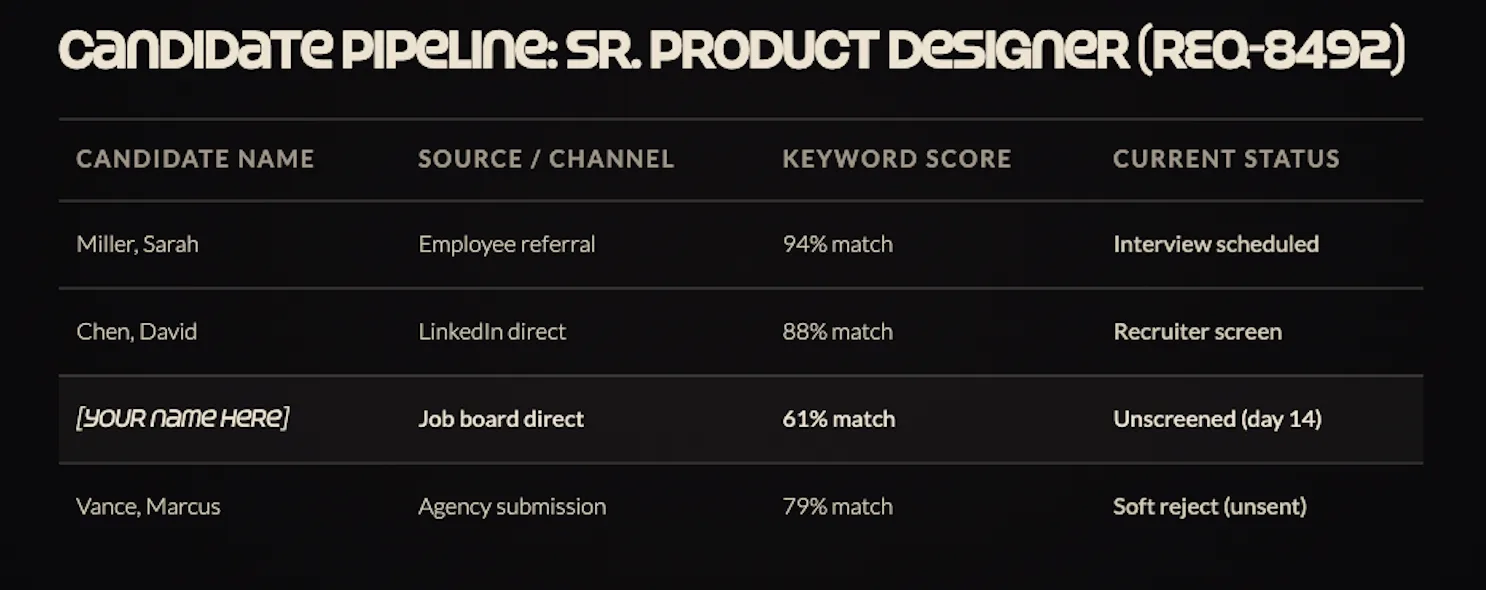
Look closely at that table. The recruiter instantly sees:
- The exact second your submission hit the server.
- The acquisition channel — whether you came from a high-priority employee referral, an agency, or the general "job board dump."
- An automated keyword match score calculated by a parser before a human eye ever touches the text.
- The exact status tag assigned to your file, including internal tags like "On Hold" or "Soft Reject" that sit silently for weeks before a batch rejection email is triggered.
They have absolute telemetry. They see the timeline, the source comparison, and the internal progression.
You, meanwhile, get nothing. You get a blank screen and a blinking cursor.
This is not a neutral marketplace. It is an information asymmetry where one party holds the entire dashboard and the other party is forced to guess whether they are still in play or already dead in the water.
II. The cost
The true cost of guessing
When you force human beings to operate inside an information vacuum, they do not simply sit back and wait. They attempt to solve the problem by tweaking variables blindly.
You rewrite your CV. You strip out the custom formatting because someone on LinkedIn said tables confuse the ATS parser. You swap out your summary statement, alter your title phrasing, and resubmit to twenty more companies.
Two weeks later, you get zero responses instead of two.
Is your new CV worse? Or was the market simply slower this week? Did the first two companies reject you because of your experience, or because they had already quietly filled the role internally before you even applied?
You cannot tell. You are attempting to run a scientific experiment where you manipulate the variables, but the readout display has been painted black.
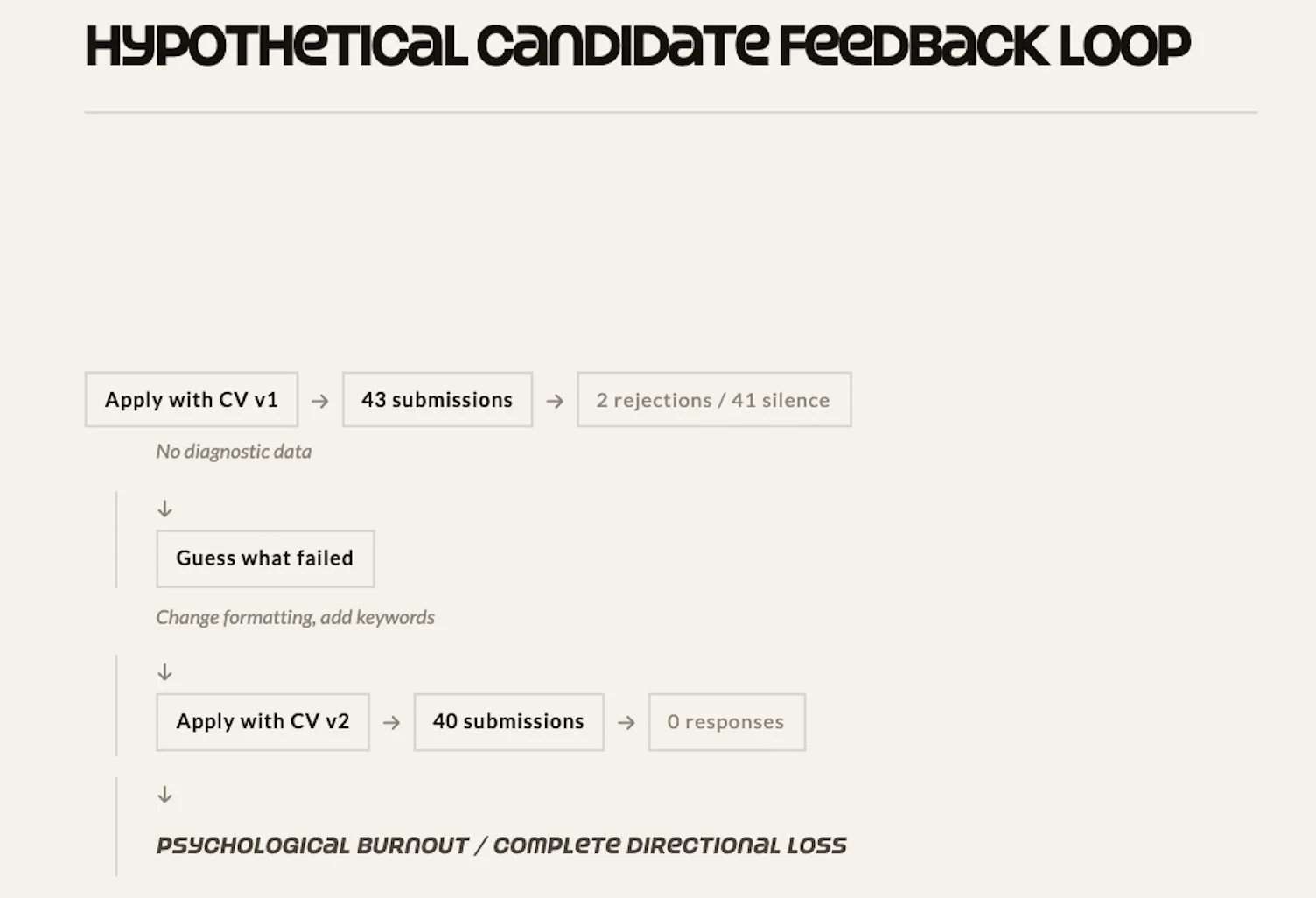
Consider the real-world mechanics of how an initial CV screen actually unfolds. Eye-tracking research conducted on talent acquisition teams demonstrates that recruiters spend an average of 7.4 seconds on an initial CV scan. In those seven seconds, their eyes scan a strict typographic path:
- Current title and company
- Previous title and company
- Start and end dates
- Core skill keywords
If your key accomplishment is sitting quietly at bullet point four under a job title that doesn't perfectly match their internal lexicon, you are marked as a pass. But because you never receive diagnostic feedback, you assume you were under-qualified. So you spend three months taking online certificates for skills you already possess, while the actual problem — a layout issue or a title mismatch — remains entirely uncorrected.
This is what degrades senior talent over time. It is rarely the rejection itself; professionals can accept a clear "no" grounded in specific criteria. What breaks people is the endless, silent compounding of invisible decisions.
III. Transparency
What structural transparency actually requires
If we were to strip away the legacy software built for high-volume corporate screening and build a hiring interaction from scratch, what would basic transparency look like?
It does not require artificial intelligence, invasive surveillance, or complex algorithmic scoring. It requires four basic conditions:
- Receipt verification: clear acknowledgment that an application reached an actual queue, distinct from an automated server confirmation.
- Diagnostic classification: an honest indication of how a file was triaged — whether it was set aside due to a structural requirement mismatch (location, salary band, specific tech stack) or evaluated and passed on by a hiring manager.
- Status realism: eliminating the practice of leaving candidates in perpetual "screening" statuses long after a position has been filled or functionally closed.
- Data ownership: giving the candidate control over their professional representation, rather than broadcasting static, unalterable PDF documents into corporate databases where they age and decay out of context.
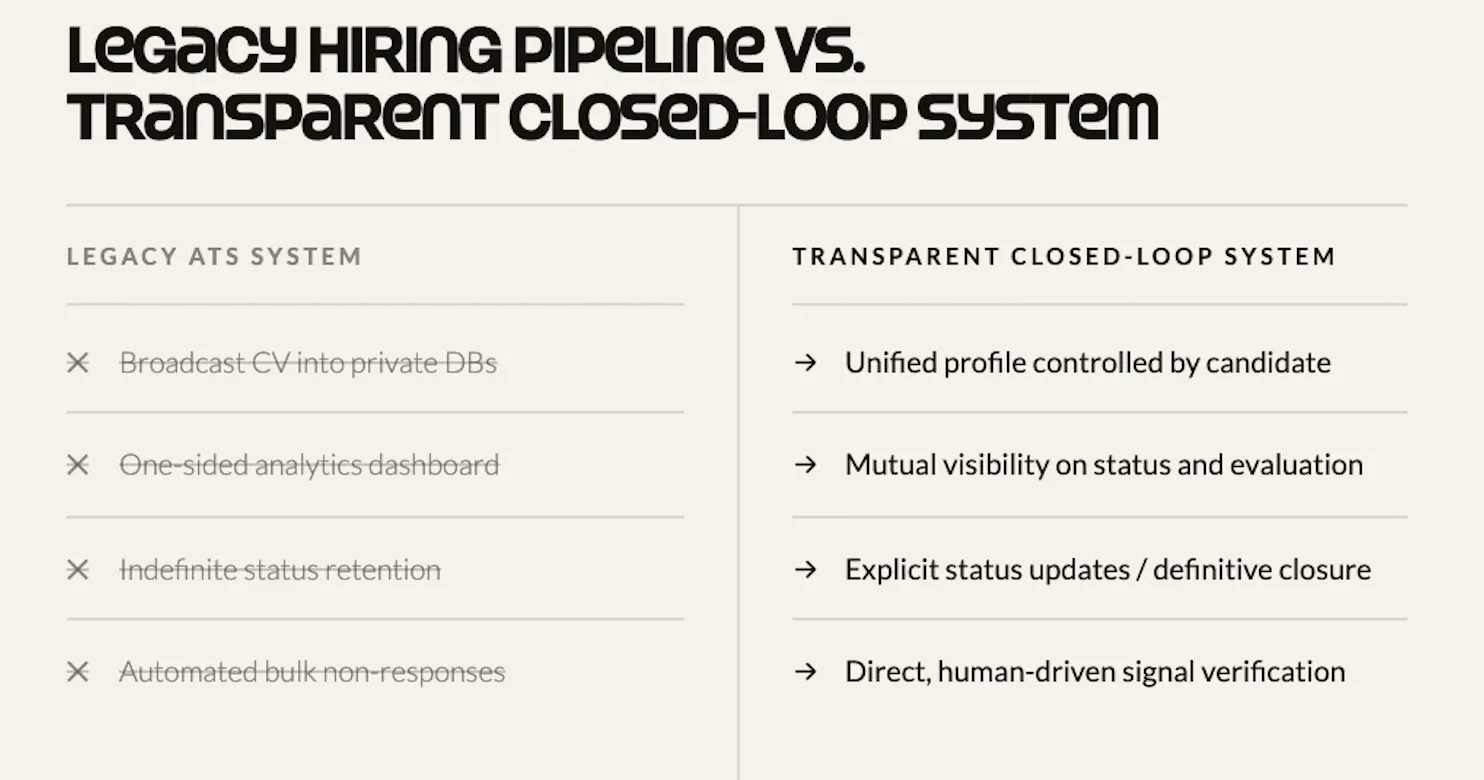
When hiring systems are built purely to protect the hiring organisation from candidate communication, silence becomes the default operating strategy. Reversing that dynamic requires changing the underlying architecture of how talent profiles are presented and evaluated.
IV. The model
The vairee model: human accountability over dashboard illusion
We built vairee because we spent two decades inside the corporate hiring machinery — across tech, fintech, SaaS, corporate companies — watching exceptional senior talent get lost inside software black holes.
We watched qualified leaders rewrite perfectly good résumés, second-guess their career trajectories, and burn out from the sheer psychological toll of unacknowledged outreach.
vairee-card was created to break that loop. But it is important to be clear about what we are doing — and what we are not doing.
We are not offering a flashy consumer tracker that monitors every micro-second a recruiter scrolls past your profile. We refuse to sell software promises that pretend to magically force corporate hiring teams into changing their behaviour overnight.
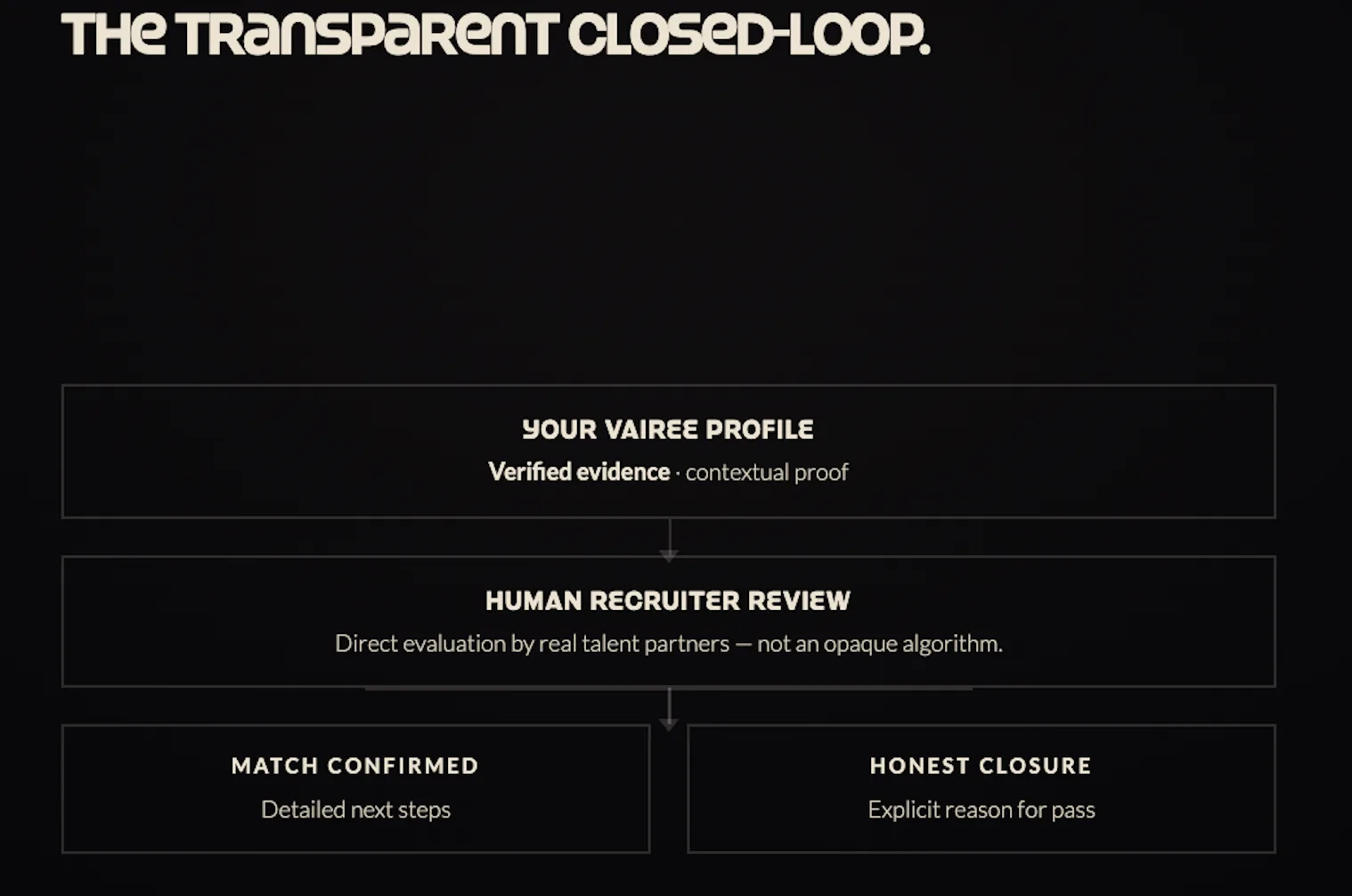
Instead, we built a closed-loop system:
- Evidence over keyword stuffing: you construct your vairee-card once. It focuses on verified outcomes, professional context, and demonstrated competence rather than arbitrary buzzword density designed to trick an ATS.
- Controlled exposure: your profile remains anonymous until you explicitly decide a role or organisation is worth engaging with. You stop broadcasting raw CV attachments into static corporate databases. However, we recommend people start using blinded profiles — no names, gender, past companies. Just skills and their talent.
- Human-driven signal: right now, in our early stage, we do not rely on automated dashboard metrics to give you a false sense of control. Every profile submission inside our network is reviewed by an actual human recruiter on our team.
- Definitive closure: when there is a fit, you are introduced directly. When there isn't a fit, you are told clearly and early. The silence is removed because we treat candidate communication as a baseline responsibility rather than an administrative burden.
This is an early-stage product (MVP). It is deliberately kept tight, focused, and human-operated while we build the infrastructure out.
V. The narrative
Reclaiming the narrative
If you are currently refreshing your inbox, wondering why forty-one companies haven't bothered to send a single sentence of response, understand this:
You are operating inside a broken system, and treating its silence as a personal assessment of your worth.
The quiet you are experiencing is not a reflection of your competence, your experience, or your value as a professional. It is the predictable outcome of hiring software engineered entirely to collect data for one side while shielding the other side from basic accountability.
Silence in hiring is a design choice. It was built by software companies decades ago to optimise recruiter throughput at the expense of candidate sanity.
It does not have to remain the standard.
If you are a senior professional ready to stop sending static documents into electronic voids, build your profile with us. Use the tool, test the structure, and tell us where it hurts.
If you are a hiring manager who wants to see how context-driven, transparent recruitment works from the inside, start by building your own profile.
We read every piece of feedback, review every profile manually, and respond directly.
Direct contact: vairee@vairee.ai.
Build your profile.
Stop sending static documents into electronic voids. Tell us where it hurts.
Build your profile